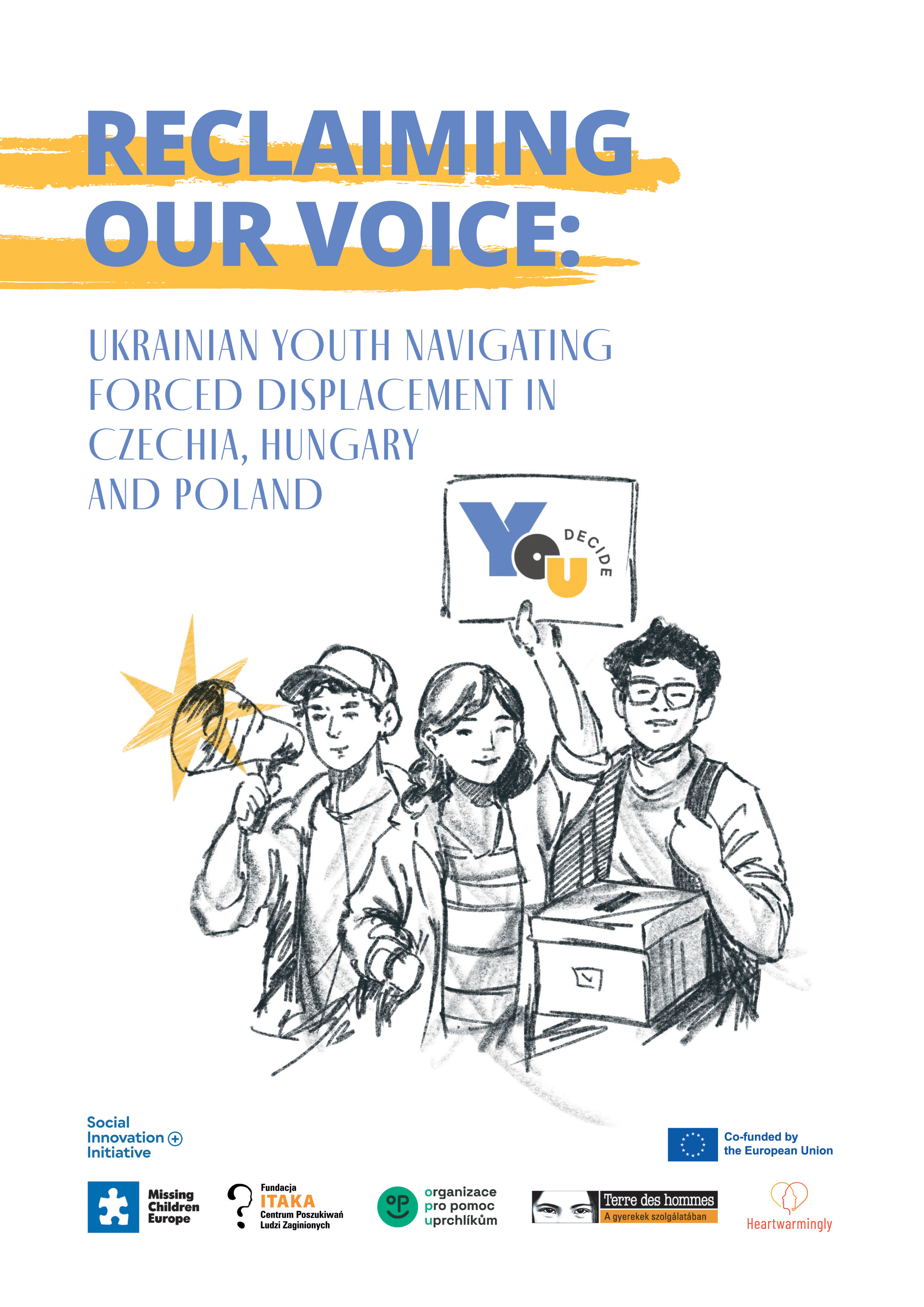
 As part of the YoU Decide project, Terre des hommes Hungary and its partners – Missing Children Europe, ITAKA Poland and OPU Czechia – co-developed the research report Reclaiming our voices: Ukrainian youth navigating forced displacement in Czechia, Hungary and Poland.
The report examines the lived experiences, aspirations, and challenges of displaced youth from Ukraine navigating the transition to adulthood in Poland, Hungary, and Czechia. It is based on participatory, trauma-informed research with 288 young people aged 15–24. Three focus groups were organised in Budapest, Prague, and Warsaw with a total of 24 participants, alongside an online survey completed by 264 children and youth between December 2025 and February 2026. While not fully representative, the findings provide crucial insight into youth voices at a critical stage of life shaped by war and displacement.
Uncertain futures shaped by legal and structural barriers
The research explores how evolving “life projects” and forced displacement shape young people’s access to education, employment, housing, healthcare, and other support services. Legal uncertainty linked to the time-limited residence rights under the EU Temporary Protection Directive – currently set to expire in March 2027 – emerges as a major source of anxiety, limiting young people’s ability to plan their future. While around half of respondents wish to remain in their current country of residence, a significant share are uncertain about what lies ahead.
Gaps in youth-appropriate support systems can increase vulnerability to risks such as going missing, labour exploitation, or trafficking. Despite their resilience and ambition, displaced Ukrainian youth face structural barriers, including language barriers, high housing costs, and precarious employment conditions, often balancing studies with informal or unstable work.
The findings confirm that youth transitions in displacement are shaped by the interaction of legal status, economic precarity, gender roles, and social belonging, with additional exclusion affecting LGBTQ+ youth and those with multiple vulnerabilities. Young people across the three countries articulated strong aspirations – developing professionally, pursuing creative careers, excelling in sport, and gaining independence – yet these aspirations repeatedly collide with the realities of displacement and limited resources.
Resilience, identity and community support
Hobbies, peer networks, and community engagement play a vital role in supporting identity, wellbeing, and social inclusion. Creative, cultural, and sporting activities provide important spaces for connection and personal development, although lack of time, financial constraints, and language barriers limit access. Young people also demonstrate strong civic participation and a desire to contribute both to their host societies and Ukraine’s future. At the same time, access to healthcare – particularly mental health services – remains uneven, with many young people facing barriers due to language, lack of information, or limited availability of appropriate services.
Call for youth-centred policies
The report calls for youth-centred policies that ensure legal certainty, facilitate access to education and employment, strengthen labour protections, expand accessible and culturally appropriate mental health support, and create meaningful avenues for youth participation in decision-making. Most importantly, it highlights the need to support young people in shaping and pursuing their own "life projects" as they transition to adulthood in displacement, ensuring that their voices and aspirations are fully taken into account in policy responses.